
Invitation: Please join me on this journey by feeling your own direct experience of what is described rather than just reading this for information.
Since childhood I carried a persistent feeling that something essential was missing. The world everyone agreed was “reality” somehow felt incomplete.
As a voracious reader, I began exploring different teachers and traditions. One teacher, Gurdjieff, admonished students to ‘Remember yourself!’. I heard this as a big wake-up call. I realized all my attention had been focused outward to others, to objects and to thoughts and feelings. I had not only neglected but completely forgotten the one behind it all – ME! This resulted in my starting a practice of two-way attention, being aware of both the external and my ‘me’ at the centre, the one receiving all the perceptions and sensations, and aware of thinking. Some teachings call this ‘mindfulness’.
Check: What is your own immediate experience – before any thought about it – when you ‘remember yourself’?
While the ‘me’ I believed to be doing this two-way looking was a great discovery and positive step forward, it still seemed less than complete. Years later, I came across some simple experiments devised by Douglas Harding (freely available online) directing one to ‘observe’ where one was looking from without any assumptions, memory or thought involved . . . ‘looking’ at one’s own self with just pure unlabelled perception. Doing this put me in touch with a witnessing consciousness before the thinking mind I had normally identified with, and I realized this is who (or what) I’ve always been – unbounded and unchanging but very alive awareness.
Check: What do you find perceptually when you look at – become aware of – where you are looking from without any preconceptions?
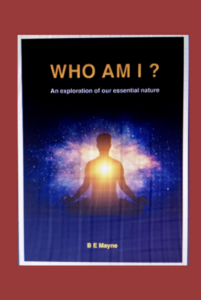
I realized that this new and now constant companion, a conscious presence, is the basis of what key spiritual traditions have been telling their followers. A few years ago, I summarized my understanding of this in the book Who Am I? – An Exploration of Our Essential Nature.
[A slideshow summary of it was presented to Intertel Europe members at the time and it was also reviewed in Mensa Magazine.]
While Who Am I? is intended to help guide others to making their own similar self-discovery, further studies found that quite long-standing traditions, notably the Indian Vedic and Buddhist ones, had different scriptures which are designed to assist the student to take the gradual steps from the consensually agreed ‘reality’ to this clear witnessing consciousness-based seeing.
The one which I have found so far to be the clearest guide is Patanjali’s Yoga Sutras, written in India in the early centuries CE. It is comprised of 196 verses which convey a careful progressive teaching, gradually leading the reader from the universal state people are in of living as if they are their minds (who they think they are) to liberation, or freedom from identification with the mind. This liberation transcends the mind’s limitations in imagined duality and realizes the oneness of awareness as what essential nature is. Such oneness (union) is the meaning of yoga.
Despite this book helping one take progressive steps; the original text is extremely terse, so guidance from interpretations with commentaries by ones who are spiritually evolved is indispensable for clarification. After having carefully studied several such commentaries, it seemed others interested might be helped if they could see this teaching in a simplified synthesis. Preparing this has also greatly helped deepen my own fuller appreciation of it.
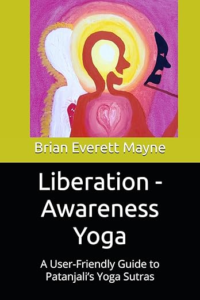
Liberation – Awareness Yoga – A User-Friendly Guide to Patanjali’s Yoga Sutras has now been published. The term ‘awareness yoga’ is used because it is not about the physical postures we often associate with the word ‘yoga’, but about a shift of identity from mind to awareness/observing presence.
Patanjali’s Yoga Sutras is comprised of 4 books.
1. Direct Perception, describing the ways in which our mind modifies reality.
2. Practice, about the suffering the mind causes and the means to bring awareness to – and freedom from – it.
3. Powers, describes the final stages of practice and how completion of these can be used to acquire seemingly miraculous knowledge and control of internal and external affairs.
4. Liberation, reiterates the path to freedom and makes clear what such Self-realization, becoming reality, means.
Books 2 and 3 contain the famous 8 limbs of yoga. We come to know ourselves through these 8 limbs, firstly through external practices and then via increasingly internal ones.
These steps include the withdrawal of attention from the senses and external distractions. This helps us become aware of our thought habit patterns and notice how – when letting ourselves be drawn outwards – we attach to, or identify with, many of these thoughts. We realize that such identification with thoughts has been defining our happiness/unhappiness and has been the cause of suffering. For example, if we feel irritated by something we hear on the news or when stuck in a traffic jam, we can ask ourself who is feeling this and who is the witness of it. The potential for this discrimination is available to all throughout daily activities.
Mind is chameleon-like, changing into whatever it ‘knows’. It becomes one with its object of focus and places what it ‘knows’ – modified by memories, associations, likes, dislikes and opinions – before the more fundamental observing presence. And it is this presence, or awareness, – not the mind – that is the true knower of everything. What mind believes it ‘knows’ is a reflection of these modified objects it has placed before awareness, the real and only knower.
Check: Who or what notices your emotions, thoughts, body sensations and perceptions?
Identifying with mind, an ever-changing kaleidoscope of thoughts, feelings and coloured, or modified, impressions unique to each person, is the source of believed separation and duality.
When followed, the Yoga Sutras’ careful teaching steps can help us to drop the illusions of mind and egoic identification, and return us to realizing the observing presence, or reality, we forgot but have never not been.
Check: What do you find when you look for yourself?
And can it be found with the mind or the physical senses?
Instead of the mind with the personality’s modifications becoming one with experience, awareness can now directly be one as reality without the mind’s modifying colourings.
This realization of awareness as our essential nature is the liberation the Yoga Sutras’ teaching is about.
We live here within the waking dream, sometimes forming very close emotional bonds with some others. When one of these close one’s physical form dies, nothing happens to their essence/awareness, as that is impersonal and indestructible AND already one with our essence. If the departed one was not liberated already (as is usually the case), Vedic teachings say what was incomplete about them remains as latent impressions (like unfinished desires and karma) which then returns for a new life to be completed. This could take many lives according to Vedic teachings – though Buddhists do not speak of rebirth. When such a one is reborn, they are naturally attracted to relationships with others (also reborn) who were with them in a previous existence. Past life readings and hypnotic regressions often point to this. Perhaps this speaks better to what you proposed? (Of course, all this is happening in our imagination – our waking dream – until we wake up from it.)
When does individuality (sense of separate beingness) start and do we ever lose the oneness we were prior to that? The individual side of us originally did not exist. Who and where were we as individuals in, say, 1949?
Even after birth, it still took some time for the intelligent awareness that we were to learn and acquire, the identifications and preferences – what we call personality and ego. So, we entered as forms associated with an essential awareness (which almost certainly in that oneness pre-existed any physical birth). Later all else was acquired/learned from outside of us, including all the ‘me, my and mine.’ The newborn infant had no ‘me, my and mine’ but did have intelligent awareness.
As it grew and developed what we call mind/ego, it increasingly identified with the learning it acquired from external sources and forgot its essential Self – but that Self is always present – like the life force – as we could not exist without its foundation.
Much of the resolution of this, for me, comes with the awareness of my state when transitioning from sleep (not yet conscious of any personhood) to waking. In that often too brief in-between state, before remembering who I am, where I am or the when of things, there is a clarity of just awareness being present AND being aware or conscious of it (which I was not during sleep – but can be more and more with practice). This awareness of awareness does not happen through physical senses – does not belong to the realm of time and space. That same awareness WAS present during sleep, but just not noticed.
Part of what is becoming increasingly evident to me is that this conscious awareness is not personal, not mine. It is the same awareness shared by all, just as all share the life force. It IS the oneness. I’ve just been imagining it belonged to me.
Also, this awareness is actually ALWAYS present but not noticed in our daily life when our attention is pulled outward to so many other objective phenomena including thoughts. It is my sense of what Roy means by presence and also that something about him that never changes.
For those interested in this subject, Brian recommends the work of DAVID BINGHAM: ‘We are already the infinite Being and always have been.’
Visit http://www.nonconceptualawareness.com/
Ideas from a Tibetan Buddhist workshop on the Afterlife
What happens to us at death? Here are some words on this from a Tibetan Buddhist perspective from a workshop given by Christine Longaker (author of Facing Death and Finding Hope ): “The extraordinary opportunity at death is the loss of personality.” “Awareness of death can be our biggest gift. It helps us to live […]
What happens to us at death?
Here are some words on this from a Tibetan Buddhist perspective from a workshop given by Christine Longaker (author of ‘Facing Death and Finding Hope’ ):
“The extraordinary opportunity at death is the loss of personality.”
“Awareness of death can be our biggest gift. It helps us to live more fully.”
“Who we think we are wasn’t before birth and won’t be after death – it’s not our original nature.”
“The darkness at death is the loss of our cloudy nature, and our real self dawns – fully awake to our [real] nature.”
“The karmic seeds of our actions, words and thoughts – our habits and conditioning – will go on after death unless purified. The point of practice is to change our habits. Develop good habits, so they naturally come to us at the moment of death . . . and we can consciously direct ourselves towards the realization of our absolute nature.”
“Our state of mind or last thought at the moment of death becomes our next reality.”“The moment of death is the crossroads of eternity. The crossroads is now. Waiting until the moment of death is too late.”
“The teaching for all the Bardos are: how do you use that particular Bardo, whether it’s this life, dying or the after-death state, to obtain enlightenment. . . . use that time to create an atmosphere of love, or peace, of non grasping . . . use that time of the moment of death to practice to obtain enlightenment.”
Essential advice for the dying person: “Be free of attachment and aversion, keep your mind pure and unite your mind with Buddha.”
“In Buddhism, healing is purification, not necessarily getting well.”
“ . . . you start to get a new passport and a new set of credit cards and, before long you’ve constructed this whole new sense of self. But is it your real self? No. You didn’t know who you were, so you took on this new identity. And it’s temporary. It will go away. It wasn’t who you really were. So, at the time of death this temporary identity that we’ve taken on disintegrates.
All the passports go back. The credit cards go back. The family history goes back. It literally disintegrates at the time of death, at the time that the body dies. Because of that, there is the extraordinary opportunity to attain enlightenment because, when the clouds are finally blown apart after a big storm, the vastness and the radiance of the sky and sun are naturally and fully revealed. In that state, we get a glimpse of our enlightened essence of our being. It’s easier to attain enlightenment if we recognize it. And this is the key to the teachings . . . if we recognize it, or if we’ve ‘died’ already through spiritual practice in a very inspired state of devotion, compassion, or just heartfelt prayer – if we die with our mind and heart in a very good or positive state – there’s more possibility that we can use that moment of death to attain liberation, because the clouds are gone, the suffering, the sense of self, all that I normally thought was me, is – for a moment – gone.”
Christine Longaker (https://www.christinelongaker.com/) writes: “My passion is uncovering the tapestry that connects us all, and seeing the weave, the colors, the light and shadow”
Koans – from a conversation with Brian Mayne
“I recently had a revelation which stemmed from a book on Koans (A ‘koan’ is a paradoxical story, dialogue, or question used in Zen Buddhism. Its purpose is to bypass logical reasoning and trigger an intuitive awakening, or sudden enlightenment, by exhausting the analytical mind) by Ross Bolater.
When we look in a mirror what we see and claim is our reflected face. What this book suggested was that ‘When we look anywhere else, do we not also see our reflected face?’ In everything, in the books, the scene from the window, the picture on the wall, why isn’t it all me, my reflected face, just as that reflection in the mirror is
To give examples: ‘Show me your face, the face you had before your grandparents were born.’ Or ‘You who Reach the top of a hundred foot pole are not yet finished. Step from the top of the pole and worlds of the 10 directions will be your body.’
There are answers that are not mental or logical ones; they must be experienced. When you step in the 10 directions, it’s actually saying ‘Step everywhere!’ In effect it is also ‘Disappear yourself conceptually. So this is what this reflection, not only in the mirror, but in everything that we see is also, for me, stepping from the top of that pole.’”
Ross Bolleter is an Australian Zen teacher, composer, and author who created modern koans and wrote books like The Crow Flies Backwards and Other New Zen Koans and Dongshan’s Five Ranks.
‘Who Am I’ By Brian Mayne
A review of the book in MENSA Magazine, December 2022
Brian Mayne has written lucidly of his spiritual journey. His life style is testimony to the efficacy of his ideas, combining as he does his work on himself with a successful business career
‘Just a few ever wonder who they really are, even fewer seriously explore the topic, and only the rarest manages the direct experience of realizing the core self. Although becoming conscious of it is a rare attainment, this ‘core self’ is accessible to all and naturally part of what we each are as human beings’.
‘Who Am I’ (A sequel to ‘Awake – Conscious Pilgrimage’} is the sharing of personal experience about the deeper mysteries of the deepest self in a form that is easy to read. The journey is as important as the arrival. He asks of himself who exactly he is. His answer in brief is that his primary self is Pure Awareness. It is not aware of anything except itself. This also means outside of time and space. In such a state we are all other dimensional. His approach is shot through with clear common sense though in places his ideas intersect with those of great mystics. His method is to ground assumptions carefully then build on them in logical steps.
Daily experience tells Mayne that he goes through three states:
- Waking consciousness in which I am ‘the Waker’ (mind, senses and actions focus outwards)
- Dreaming sleep in which I am ‘the Dreamer’ (mind focus inwards)
- Deep dreamless sleep, when I am ‘the ‘Sleeper’ (mind does not function at all and I am not even aware of my physical body}
NB Some might demur at the proposition that the mind does not function ‘at all’ but the insight throws up intriguing questions, viz:
If I were my body-mind complex, my life would stop each time I enter deep sleep and start each time I dream or wake up. If so, who is it who remains during deep sleep?
Is it (like) pre-life, (this) deep dreamless state when unaware of the body?
Who am I if not the mind or body that I am witnessing? What was it that was there in the mind’s beginning to learn all that it knows?
This leads Mayne to posit:
‘After some period of contemplating it, we realize that it … must be objective because there is a witness to it… Who I am must be the subject ‘me’ rather than an object…I observe and feel my body, it is an object to my real identity, and I am as the observer and experiencer of it. Similarly, I witness my mind and its thoughts, so who I am cannot be my mind or my thoughts… I must be the innermost ‘me’, ‘me’ at source, rather than anything external which would therefore be separate from this ‘me’.
Awareness is another name for you. Who we are must be the unchanging reality behind the senses. Waking to this awareness is an actual direct experience of coming home to who we already are and have always been.
One’s primary identity is pure awareness rather than consciousness and unconsciousness associated with the human mental states of waking, dreaming and deep sleep.
Our intelligent awareness had to have already been present in the womb A body could only have been created by a pre-existing intelligence, or intelligent awareness…. Since you are awareness there is no need to attain or cultivate it.
This approach leads Mayne on to several further conclusions.
This awareness is timeless. Who we really are never was born and therefore never can die.
To discover who you are, all that you have to do is to give up being aware of other things. It is a conscious direct experience of one’s state outside of the mind which will bring this truth home.
Everything is within the sphere of pure awareness, but pure awareness is senior and cannot itself be witnessed by anything within it.
The subject/source for all objects and even for itself is my awareness, an intelligence alive to itself which can experience everything, but not itself be experienced by anything external to it.
NB A question arises of whether a human being is akin to the universe in a microcosm form. Mayne’s comment here is that ‘if we are microcosms of the universe. If pure awareness is reality and oneness, there is no universe – except in the realm of time and space. Pure awareness is outside of time and space. Manifested realms and beings, are more of a relative reality, and are at best extensions of the pure awareness – or some say consciousness. As you’ve noted: ‘Everything is within the sphere of pure awareness.’ In Hindu terms this is all Maya/illusion. What this means is that what we consider to be reality, the waking state of the mind, is not reality at all. When our physical forms came to this realm of time and space we were brainwashed into believing we are human beings in time and space, but we have never lost the awareness which is our reality and we can find it again if we truly wish to. This means that who we are was never born and being eternal can never die. Effectively this is what spirit is. However, it has always been a mistake to confuse spirit with the physical-mental self. ‘
All that is left is what then might be considered eternal unbounded space of pure awareness . . .without any separate subject, object or even thought. It is timeless and unchanging and it follows that it does not die.
If we close our eyes and step back from the senses and the mind, what we are left with is an alive space which is pure awareness alone. It is a shifting from outer attention and activity to that ‘space’ of inner still awareness which is a oneness without boundaries.
That awareness is with us in our waking activities but forgotten in the distractions of the mind and pull of the senses.
We are in a state of pure awareness in deep sleep but not conscious of it. When we awaken, there is an extremely brief transition from sleep to the mind and personality re-engaging, when we remember and re-establish who we are in our waking state. When we ‘catch’ that brief instant, which is awareness before the mind starts, it becomes a benchmark for us and, with practice, the duration of this state of just awareness can be extended for longer and longer periods.
This reality is characterised by great peace. It is experienced during deep dreamless sleep when awareness of the body and mind are absent . . . but a pure awareness of ‘nothingness’ remains present. Being cannot be experienced as an object, as a sensation, or mental state because it is non-dual. We can only BE it. It is always available if we drop all thinking, wanting or any form of mental activity for a moment and rest as IT.’
Ideas follow as to how to live one’s life in accordance with this understanding, for instance meditation that helps withdraw attention from thoughts and external inputs, perhaps becoming aware of a part of the body – a toe, say – and then step back to that which is the awareness.
One should be open to intuitive wisdom…. A first step is releasing long-cherished beliefs and convictions about who we identify ourselves as being’. This becomes easier when we realize what we intuitively knew and recognized about the already wholeness of our essential aware selves.
Self-realisation can come from a combination of sources, such as the right teacher/s, nature, life experiences, studies and/or even from inside oneself. This also requires the use of discrimination, discernment, and resonance to understand and intuitively recognize the truth of such teachings. Grace can come as well in forms that the mind may have thought of as being negative. Shocks to motivate us to new clarity and evolution. When our mind is open and the self is the base of our identity, the mind can be used without our losing oneself in being a temporal mind and body. Accordingly, we should avoid negative thoughts and cherish positive ones, avoid judging and harming others and cherish respect for all life.
When we identify with being a mind and body, we create a prison for ourselves in time and space. The mind creates its world through imagination. All fears and suffering are linked to time and space. (In doing that) We have forgotten our divine self, the space of intelligence and love, the pure ‘I am’ of our being.
Mayne experiences the problem that confronts many a spiritual teacher: that of writing about a world which the tool of language is inadequate to accurately depict. He has used his ability to think logically, and consider his persona calmly, to help uncover a subjective truth that is also an objective truth for us all. It is a message of hope but, above all, for common sense. It is not breathless enthusiasm or dogged adherence to any cult or Faith. We are entitled to use our minds to go as far as we can into an opaque world but which must be there for all of us, whether or not it can be ‘bottled in a test tube and refined in a laboratory’. If we desire to know why we are on this earth and to live life according to precepts that are attuned to our essential selves, Mayne’s text as a starting point is as good a place to begin as any.
Coda to Brian Mayne Review
Mayne elucidates: re ‘if we are microcosms of the universe.’ If pure awareness is reality and oneness, there is no universe – except in the realm of time and space. Pure awareness is outside of time and space. Manifested realms and beings, are more of a relative reality, and are at best extensions of the pure awareness – or some say consciousness. ‘Everything is within the sphere of pure awareness.’ In Hindu terms this is all Maya/illusion. What this means is that what we consider to be reality, the waking state of the mind, is not reality at all. When our physical forms came to this realm of time and space we were brainwashed into believing we are human beings in time and space, but we have never lost the awareness which is our reality and we can find it again if we truly wish to. This means that who we are was never born and being eternal can never die. Effectively this is what spirit is. However, it has always been a mistake to confuse spirit with the physical-mental self.